Shared vs. VPS vs. Dedicated: Which Hosting Fits Your Business?
When you launch a website, you aren’t just uploading files to the internet; you are renting a physical piece of real estate on a server somewhere in the world. And just like buying a home, the type of real estate you choose determines how comfortable, safe, and scalable your life will be.
For new business owners and developers, the terminology can be overwhelming. Shared Hosting, Virtual Private Servers (VPS), Dedicated Rigs, Cloud Clusters—what does it all mean, and more importantly, what do you actually need?
In this comprehensive guide, we are going to demystify the three pillars of web hosting. By the end of this article, you will know exactly which infrastructure will power your success in 2026, saving you money and preventing future headaches.
1. Shared Hosting: The “Apartment Complex”
Shared hosting is the entry point for 90% of websites on the internet. It is affordable, user-friendly, and usually comes with “one-click” installers for platforms like WordPress.
How It Works
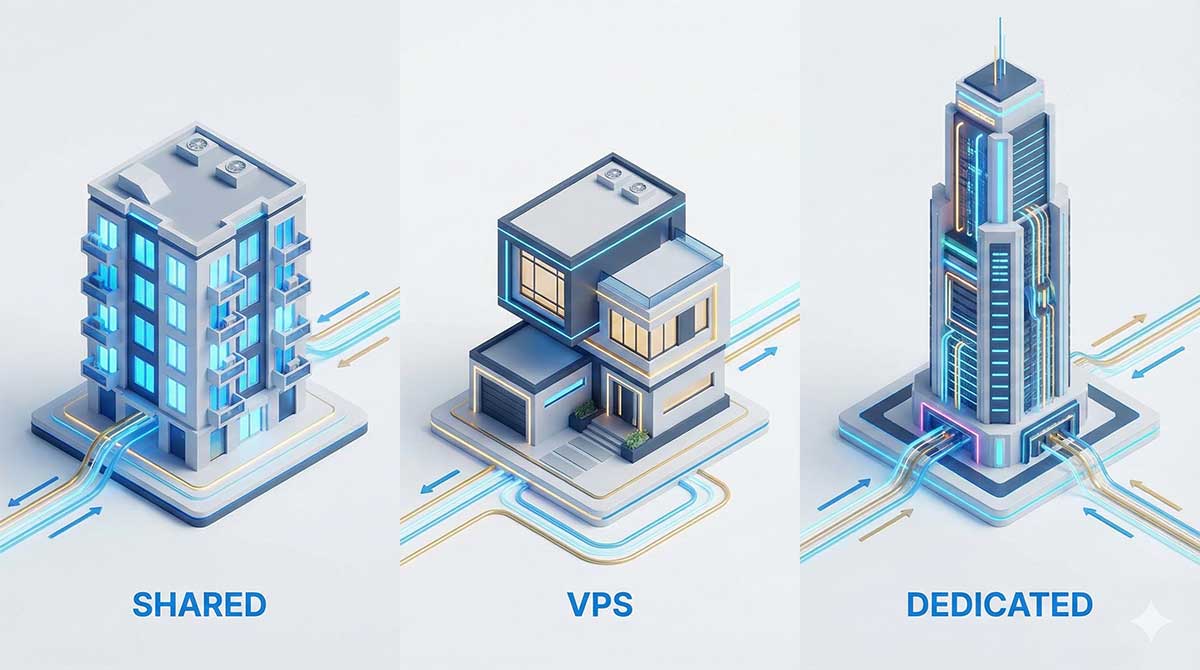
Imagine living in a massive apartment complex. You have your own private unit (your website account), but you share the building’s resources—water, electricity, and the swimming pool—with hundreds of other tenants.
In server terms, your website resides on a single physical server alongside hundreds of other websites. You all share the same CPU, RAM, and bandwidth.
The Pros
-
Cost-Effective: Because the cost of the server is split among many users, plans can be incredibly cheap (often the price of a cup of coffee per month).
-
Beginner Friendly: Shared hosting usually comes with a control panel (like cPanel) where the host manages the technical maintenance, security patches, and software updates.
-
Pre-Configured: The environment is ready to go immediately. You don’t need to know Linux code to get started.
The Cons
-
The “Noisy Neighbor” Effect: If one website on your server suddenly gets a massive viral spike in traffic or is attacked by hackers, it can drain the server’s resources, causing your site to slow down.
-
Limited Customization: You generally cannot install custom software or modify system files because doing so might affect other users.
-
Security Risks: While reputable hosts isolate accounts, sharing an IP address with a spammy website can sometimes affect your email deliverability.
Who Is It For?
Shared hosting is perfect for personal blogs, portfolio sites, small local businesses, and startups just testing their MVP (Minimum Viable Product). If you expect fewer than 10,000–20,000 visitors a month, this is your starting line.
2. VPS Hosting (Virtual Private Server): The “Townhouse”
As your business grows, you might find Shared Hosting too restrictive. Your site starts loading slower during peak hours, or you need specific software that shared plans don’t allow. Enter the VPS.
How It Works
A VPS is still technically on a shared physical server, but it uses virtualization technology (like KVM) to create a completely isolated environment.
Think of it like a Townhouse. You might share a wall with a neighbor, but you have your own private entrance, your own driveway, and most importantly, you have your own dedicated allocation of resources. Even if your neighbor throws a massive party (high traffic), it doesn’t affect your peace and quiet.
The Pros
-
Dedicated Resources: You are guaranteed a specific amount of RAM, CPU cores, and storage. No one can “steal” your resources.
-
Root Access: You get full administrative control. You can install any software, change OS settings, and configure the firewall exactly how you want.
-
Better Security: Because your environment is sandboxed, vulnerabilities in other sites on the physical server cannot cross over to yours.
-
Scalability: If you need more RAM, you can usually upgrade your plan instantly without migrating your data.
The Cons
-
Higher Cost: VPS hosting is more expensive than shared hosting, though still significantly cheaper than a dedicated server.
-
Technical Knowledge Required: While “Managed VPS” exists, “Unmanaged VPS” requires you to know how to maintain a server, run updates, and fix issues via the command line.
Who Is It For?
VPS is the sweet spot for growing e-commerce stores, high-traffic blogs, web designers hosting client sites, and businesses running custom web applications. If speed and reliability are crucial to your revenue, you should be on a VPS.
3. Dedicated Hosting: The “Mansion”
This is the heavyweight champion of hosting. When you buy a Dedicated Server, you are renting an entire physical machine in a data center. No virtualization, no sharing, no neighbors.
How It Works
It is exactly what it sounds like: a physical box with powerful processors, terabytes of SSD storage, and massive RAM sticks, all dedicated 100% to your website. You have the keys to the mansion.
The Pros
-
Unmatched Performance: With no virtualization layer and no resource sharing, your website can handle massive amounts of traffic at lightning speeds.
-
Total Control: You can configure the hardware (RAID setups), the Operating System, and the security protocols down to the finest detail.
-
Security & Compliance: For industries like Finance or Healthcare (HIPAA), dedicated servers offer the isolation required to meet strict data privacy regulations.
-
Private IP: You are the sole user of your IP address, protecting your reputation.
The Cons
-
Cost: This is the most expensive option. You are paying for the hardware, the rack space, the power, and the cooling.
-
Maintenance: Unless you pay extra for “Managed Dedicated Hosting,” you are responsible for everything. If a drive fails or the OS crashes, you (or your IT team) need to know how to handle it.
Who Is It For?
Dedicated servers are for large enterprises, massive e-commerce platforms (like Amazon or eBay scale), media streaming sites, and applications that process huge datasets.
The Comparison Matrix: A Quick Look
| Feature | Shared Hosting | VPS Hosting | Dedicated Server |
| Cost | $ | $$ | $$$$ |
| Performance | Good for low traffic | High Performance | Maximum Performance |
| Scalability | Low | High | Medium (Requires hardware upgrades) |
| Security | Basic | Advanced | Maximum / Custom |
| Technical Skill | Beginner | Intermediate | Expert |
| Best For | Blogs, Small Biz | Growing Stores, Apps | Enterprise, Big Data |
4. Critical Factors to Consider Before Buying
Regardless of which type you choose, there are three non-negotiable features you must look for in a provider like Bluechipspace in 2026.
1. Storage Technology (HDD vs. SSD vs. NVMe)
Never settle for a host using old spinning Hard Disk Drives (HDD).
-
SSD (Solid State Drive): The standard. Fast and reliable.
-
NVMe (Non-Volatile Memory Express): The future. NVMe drives are up to 6x faster than standard SSDs. If your host offers NVMe, your website will load instantly.
2. Uptime Guarantee
Uptime is the percentage of time your website is online. A 99% uptime sounds good, but that actually means your site is down for 3.65 days per year.
Always look for a 99.9% or 99.99% uptime guarantee. This ensures your business is always open.
3. Customer Support
Server issues don’t happen only during business hours; they happen at 3 AM on a Sunday. You need a host that offers 24/7/365 support. Test their chat before you buy—if they take 20 minutes to reply to a sales question, they will take longer to reply to a crisis.
Conclusion: Making the Right Choice for Your Growth
Choosing a hosting plan is not a marriage; it’s a stepping stone.
If you are just starting out with a new idea, start with Shared Hosting. It keeps your costs low while you validate your business model.
Once you start seeing traction—maybe you’re hitting 1,000 visitors a day, or your online store is generating consistent sales—upgrade to a VPS. The speed boost will improve your SEO rankings and user experience, paying for itself in increased conversions.
And finally, when you dominate your niche, the Dedicated Server will be waiting for you.
At Bluechipspace, we offer infrastructure for every stage of this journey. From affordable starter plans to high-performance cloud VPS, we provide the digital foundation so you can build the skyscraper.
Ready to launch? Check out our hosting plans today and build your future on a solid foundation.